One of the treasures in Museum of the Royal Tombs of Sipan.
 The imposing pyramid architecture of Lambayeque's Museum of the Royal Tombs of Sipan.
 Huaca del Sol as seen from the southeast, with the Moche River delta beyond and city ruins in the foreground.
 Geometric designs and seabirds on walls of the vast city of Chan Chan, the capital of the Chimu culture, near Trujillo, Peru.
 Mural at Huaca de la Luna of the Decapitator, the Moche god to whom human victims were sacrificed.
 Trujillo tour guide Laura Duran Perez cuddles a Peruvian hairless dog.
 Basket of peppers at La Rosa Nautica restaurant on Lima's waterfront.
 Catching a wave off one of Lima's popular surfing beaches.
 Peruvian fisherman launches his reed boat off the beach at Huanchaco on the country's north coast.
 Peruvian students learn about their national heritage at the Hauca el Brujo archeological complex 60 km north of Trujillo.

Northern Peru refreshingly friendly, and so different
By Lorne Mallin
TRUJILLO, Peru — For Manitobans who love to winter in the desert, here's something new. Expand your horizons far beyond Arizona across the equator to the north coast of Peru with its endless sands flanked by Pacific surf and the majestic Andes mountains.
The long Peruvian coastal desert, which varies from about 65 to 160 kilometres wide, is a treasure trove of temple and pyramid ruins called huacas, the legacy of cultures much more ancient than the Incas going back as much as 5,000 years.
There are ecological wonders in such nature reserves as the "dry tropical forest'' with its abundance of exotic birds and carob trees. Plus marvellous beaches to relax on and waves that attract surfers from all over the world.
While it certainly costs more to fly to South America than, say, Phoenix, the hotel and restaurant expenses here can be a fraction of what vacationers pay closer to home.
And Peru is so different as well as refreshingly friendly. So few Canadians have touched down here that you feel like an explorer. The bonus being that on the other side of the equator it's solidly into summertime now. The best of the heat in the arid desert continues through March.
The country is about twice as big as Manitoba, with a population of more than 28 million, of whom more than half are reported to live on less than $2 a day. It's bordered on the north by Colombia and Ecuador, on the east by Bolivia and Brazil, with Chile in the south and the Pacific Ocean in the west.
You can see everywhere that compared to Canada, Peru has retained much of its aboriginal heritage. Their first nations people are 45 percent of the population, plus another 37 percent of mixed heritage. Only 15 percent are of European descent.
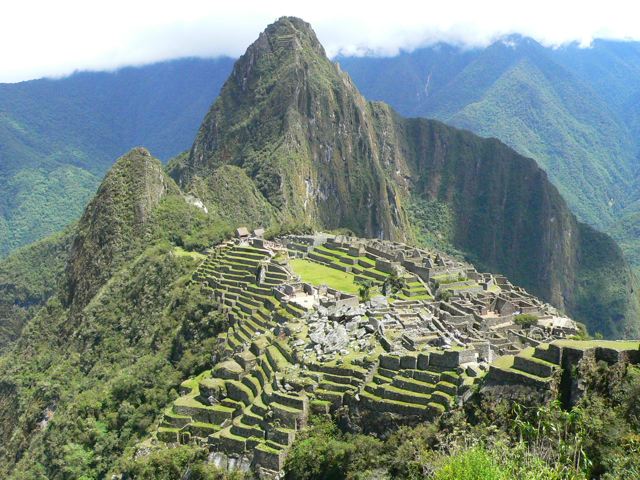
After six days on a tour of the north coast, my senses were whirling from the richness and complexity of the country's history. Most everyone has heard of the Incas and their most-famous wonder of the world -- Machu Picchu. It's reached by turning south from Lima and embarking, if you're hardy, on the Inca Trail, from Cuzco in the Andes, or take the train like I did.
Instead, I headed north on what I call the "huaca trail.'' Many other civilizations predated the 16th-century Spanish conquerors with lost cities that will excite even the most jaded traveller. All from huacas, which look like large dirt hills made out of mud bricks but are so much more.
Thanks to an explosion of archeological discoveries in the last 20 years, fantastic pyramids, temples and amazingly intricate artifacts -- many in gleaming gold and precious jewels -- are emerging from hundreds of huacas.
Peru's charms are not all about digging in the dirt. The food is wonderful. We launched our adventure on Lima's seashore at the excellent La Rosa Nautica restaurant, perched over the ocean. At a table with a view of surfers riding the waves, we were introduced to the two main themes, at least for me, of our dining delights -- ceviche and pisco sours.
Our ceviche was chunks of raw sea bass marinated in lime juice and garnished with onion slices and seaweed. Very tender and flavourful and much more like cooked fish than sashimi. Pisco sours are a deceptively mild cocktail of a regional grape brandy called pisco, lemon juice (Peruvian lemons taste more like limes), egg white and sugar syrup, then shaken or blended, and topped with a dash or two of bitters.
Also in Lima, we got a taste of the sophistication of early Peruvian cultures at Larco Herrera Museum, which houses a unique collection of erotic ceramics from the Moche era (about 200-800 AD). They're very artistic, humorous and highly explicit with grandiose depictions of phallic dimensions.
That night we flew less than an hour north to Trujillo, a coastal regional capital of about 760,000 in the Rio Moche Valley, where our exploration of the huaca trail began. It's well worth spending time seeing the streets, churches and mansions of the colonial city, founded by the conqueror Francisco Pizarro in 1534, a year before establishing Lima.
We headed about 10 kms southeast of the city to the massive Moche-era pyramids called Huacas del Sol y de la Luna (Temples of the Sun and the Moon). The largest pre-Columbian structure in the Americas, the Huaca del Sol was built from an estimated 140 million adobe bricks and was finished about 600 AD. It was damaged by the Spaniards and more modern-day looters, and about a third has been washed away by rains, the heaviest and most damaging from the weather phenomenon known as El Nino.
Welling up usually once or twice a decade, El Nino at its worst devastated crops and villages, driving temple priests to step up their human sacrifices. The smaller, more-detailed Huaca de la Luna contains colourful murals, many with the striking figure of the Decapitator, the Moche god to whom victims were sacrificed. El Nino is still a potent force in the region, causing months of catastrophic rains in 1998.
Another tremendous site in the Trujillo area is Chan Chan, at 28-square-kilometres the largest city in the Americas before the Spaniards. It dates from 1300 AD and was built by the Chimu culture (about 850-1470 AD) as their capital. Geometric designs and images of fish and seabirds have been restored on the walls of a vast plaza and other complexes. Standing in the plaza, I could imagine being transported back to a time of massed ancient rituals.
Off the beaten path about 60 klilometres north of Trujillo off the Panamerican Highway, we visited the Huaca el Brujo (Wizard or Sorcerer) with its magnificent murals. The resident archeologists took us behind the scenes in their labs to reveal in a large cardboard box the mummified remains of the tattooed Lady of Cao, who graced the June 2006 cover of National Geographic magazine.
Further north we explored Tucume, a huge site with at least 26 pyramids. Closer to the large city of Chiclayo, population 600,000, we were amazed by the jaw-dropping beauty of the intricate gold artifacts at the Royal Tombs of Sican Museum. The museum itself is a marvel of architecture, shaped like the ancient treasure-filled pyramid that archeologists explored in 1987.
Further east, the Bosque de Pomac Historic Sanctuary encompasses dozens of huacas from the Sican or Lambayeque culture (around 800-1300 AD) in its almost 6,000 hectares of dry tropical forest. The sanctuary includes 27 bird species, such as the vermillion flycatcher and Peruvian pygmy owl, and thousands of carob trees. We were extremely lucky to view an active dig in the sanctuary and be guided by Dr. Carlos Elera Arevalo, a Peruvian who earned his doctorate at the University of Calgary and is director of the Sican National Museum in Ferrenafe.
By the way, if you can't make it to Peru, you can see 120 gold and ceramic objects excavated from a Sican tomb at the Canadian Museum of Civilization in Gatineau, across the river from Ottawa. The exhibit, Secret Riches: Ancient Peru Unearthed, is on display until April 27.
IF YOU GO
Getting there: You can fly to Lima on Air Canada or LAN Peru, which also has connecting flights to Trujillo.
Where to stay: In Lima, the Posada Olivar; in Trujillo, the Gran Marques Trujillo; in Tucume, Los Horcones; in Chiclayo, the Gran Hotel Chiclayo; and a great new boon to travellers, the new Ramada is a few metres from baggage claim at Lima Airport.
Getting around: There are many ways to save money in Peru but a good guide for the huaca trail is essential. You can take specialized archeological tours with companies like InkaNatural Travel - www.inkanatura.com. Our tour guide, Laura Duran Perez of Trujillo, was invaluable. E-mail lauraduran@yahoo.com. I didn't hire a guide on my own for Machu Picchu and ended up feeling I missed worthwhile insights.
Information: The Peruvian government's travel website is great -- www.peru.info/perueng.asp. Lonely Planet's Peru book is a solid guide.